Some thoughts around User Generated Content

User Generated Content is all the rage on the internet. Large billion dollar businesses such as YouTube, Facebook, Twitter and Yelp rely solely on their users to generate their content. All they provide is a platform where users can post content and share it with their friends or the world at large. And it is rare that these large businesses compensate their users for creating this content. It begs the question: Should this desire to create content be leveraged inside the enterprise to create learning?
 
I recently came across an excellent post by John Hathaway at the Velocity Made Good Leveraging Learning Blog about User Generated Content in Learning. John suggests that the question is not IF but WHEN. Here’s a quote from the post:
 
“So, let’s ask the question “When should we use User Generated Content?” To me, the answer depends greatly on the nature, audience, and goals of the content.”
 
 
In the post, he goes on to suggest that while core content critical to the business should probably be produced through a formal and structured process, niche content doesn’t need to be. Particularly because it’s possible that you’re not creating it currently because it has a niche audience and producing formal learning is not cost effective.
 
Read the full post here and let us know in which areas in your organization would YOU be comfortable with content generated by your end users.

reBlog: Dan Roam: Healthcare on the back of a (4) napkin(s)

Dan Roam has an excellent presentation on SlideShare about the questions around Healthcare reform in the U.S. The post on his blog that lead to the presentation on slideshare is here.

reBlog: What Training Costs Part I: Converting Content from ILT to WBT – Velocity Made Good

Awesome post by Beth Chmielowski at VMG  on the cost of building online training.

What Training Costs Part I: Converting Content from ILT to WBT – Velocity Made Good

Shared via AddThis

David Heinemeier Hansson at Startup School 08

Like many people out there, I keep thinking about starting a business. I really enjoyed this back-to-basics reality check from David Heinemeier Hansson from 37Signals  (more about them here )


via inter sections blog

p.s. I also love the Omnisio video player interface & features…I looked them up and (predictably) they’ve been acquired by Google.

reBlog from humancapitalist.com:How Important is Private Equity in Human Capital and Talent Management?

I’ve been watching with some interest this trend of private equity firms buying talent/learning management vendors. Jason Corsello at Human Capitalist writes a great article about this trend here: humancapitalist.com, The Human Capitalist » How Important is Private Equity in Human Capital and Talent Management?, Jul 2009

You should read the whole article.

Trying Flock again..

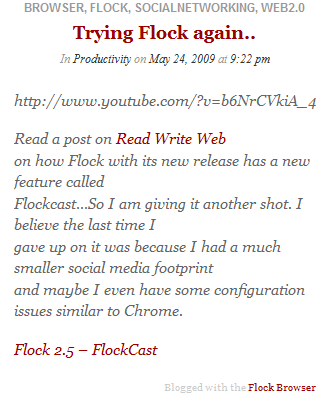
Read a post on Read Write Web on how Flock with its new release has a new feature called Flockcast …So I am giving it another shot. I believe the last time I gave up on it was because I had a much smaller social media footprint and maybe I even had some configuration issues similar to Chrome.

Update:
The picture below shows what the post looked like when I posted from Flock. The text was in italics. The video didn’t show. Either I didn’t use the Blog Editor right, or someone forgot to test it with wordpress or my WP Template messed it up.

flock-post
Flock did send out a ‘cast’ to Facebook. I was expecting a tweet too!
flockcast on fBt

I was compelled to return to WordPress to edit the post to match the look and feel & the issue with the YouTube embed.

So what’s the early verdict?

I like it. And I’m willing to give Flock a shot for this week at home and see if the features really help. More soon!

July 27, 2009 Update:

It’s been a while and I am back to using Firefox. Why? Flock clutters the browsing experience. All the add ons are distracting and I am more comfortable compartmentalizing my blogging, browsing and social networking.

How Jack in the Box does Nutrition Facts

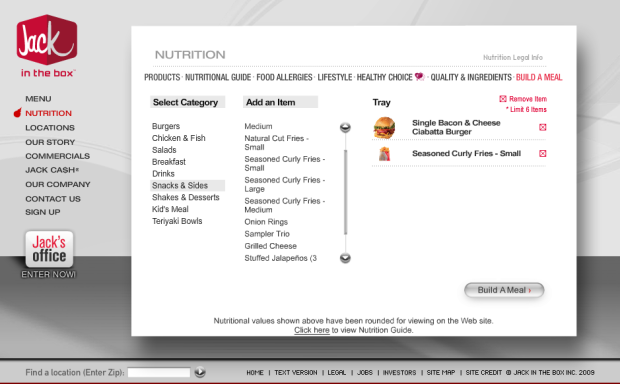
JackInTheBox-NutritionFacts

My current role at work involves providing functional input for an online tool we’re designing. This has involved preparing screen mockups for the application interfaces, designing workflows etc. So I am always on the look out for good examples of user experience design particularly form and workflow designs.

The other day when I had a particularly satisfying burger at the Jack in the box I was compelled to seek out its nutrition facts. (Because anything that tastes that good cannot be good for you.)I loved what the web designers at Apollo Interactive had put together.

I even did a little narrated screen capture video.Check it out!

Rounding

krishna_arjunThis relates to the previous post I wrote about Performance Reviews. Here’s a way managers can get started on coaching their direct reports regularly as suggested by Kris Dunn. The practice is called rounding. I heard about it at the HCS Certification course I attended from a HR leader at a healthcare organization in Northern California who adapted this practice from nursing.

Rounding is a weekly 10 minute check-in meeting that a manager has with their direct report in which they ask the following 5 questions:

  1. Who should I recognize in our team?
  2. What’s working well?
  3. What can be improved?
  4. Do you have the tools, equipment and resources to do your job?
  5. How can I help you?

I thought it was a clever adaptation. I found the the length and format attractive. I think it would increase the likelihood of managers talking to their direct reports to get that dialogue started which is the basis of coaching.

Your thoughts?

Performance Reviews

I’ve been working on a talent management project at work for the past few months. This past week I have been obsessed with learning more about performance reviews. Specifically, I am looking for a story about a company where the performance review process WORKS and employees genuinely LOVE it.  Every company has a performance review process and yet, I haven’t come across anyone who has told me unequivocally that they like it.

The most provocative article I read is Prof. Culbert’s article in the Wall Street Journal.  In this article he essentially calls for scrapping the performance review (because it “destroys morale, kills teamwork and hurts the bottom line.”) and replacing it with something called a Performance Preview (“Reciprocally accountable discussions about how boss and employee are going to work together even more effectively than they did in the past”).

The article ticked off some HR folks and they responded with their blog posts. The best rebuttal in my opinion came from Kris Dunn in an article for Workforce Management called “Want to Kill the Annual Performance Review? Step Up or Shut Up!” (Available by registration at http://www.workforce.com ) The article is summed up by this one sentence from the article: “You can only throw out the annual review if your managers can do one very important thing—coach talent on a daily basis.”

I am still searching for that story I mentioned earlier (Performance review process that everyone likes). Do you know of one?